Saturday, 8 February 2014

Episode 5 // Lunar New Year

This week's episode explores a variety of Lunar New Year festivities, including Tet (in Vietnam), Losar (in Tibet), Spring Festival (in China), Seollal (in Korea), and Tsagaan Sar (in Mongolia) -- featuring Chinese lute music from the acclaimed pipa player Wu Man, a film score by avant-garde/kosmiche German band Popol Vuh, a 5000-year-old circle-dance tradition from Korea, and some Mongolian throat-singing.

This week's episode also makes nods to the Shēngxiào's Year of the Horse. It's been difficult to trace the origins of the Shēngxiào (translated literally as 'birth likeness', sometimes known in English as the Chinese Zodiac), but groups of twelve animals began appearing in the Zhan Guo Period (Warring States Period), and a fixed list of twelve animals emerged by the Han Dynasty. Traditions related to associating birth years with the twelve zodiac signs were popularized during the North Zhou Dynasty (557-581 C.E.). Below is an image of Ai Wei Wei's 'Circle of Animals / Zodiac Heads' exhibit -- based on traditional zodiac sculptures from the fountain clock of Yuan Ming Yuan (Old Summer Palace), before they were looted by the French and British in 1860 during the Second Opium War. (Image Source: Ding Musa at LACMA)


0:00:51 - psa: Noam Chomsky on community radio
0:01:37 - station id: Amy Goodman
0:01:52 - promo: Brother Brian's Bluegrass (radio show)
0:02:40 - Beach Fossils - 'The Horse'
0:05:26 - Yao Min & Yao Li - 'Gong Xi, Gong Xi (Congratulations)'
0:08:21 - Popol Vuh - 'Kailash' (film score)
0:0":""' - talking: on Losar (Tibetan Lunar New Year), pilgrimage to Mount Kailash, [1], [2]
0:12:57 - Traditional (Smithsonian Folkways) - 'Dropa (Two Shepherd Songs)'
0:15:01 - Techung - 'Losar'
0:20:03 - promo: CFRC Funding Drive Poetry Event
0:20:34 - promo: CFRC Funding Drive Teaser
0:21:08 - Doan Ca Hue - 'Long Ngam (Dragon Recitation)'
0:23:04 - Dinh Dung, Thu Hang, Doan Ca Kich Hue - 'Ho Gia Gao (Chant of Pounding Rice)'
0:27:54 - Doan Ca Kich Hue, Hien Luong - 'Doan Xuan (Spring Unity)'
0:29:00 - Popol Vuh - 'Kailash' (film score)
0:"":""' - talking: on Tet (Vietnamnese Lunar New Year), pipa player Wu Man
0:31:49 - Wu Man - 'White Snow in a Sunny Spring'
0:35:08 - The Shins - 'Mine's Not a High Horse'
0:38:28 - The Heliocentrics & Mulatu Astatke - 'Chinese New Year'
0:42:15 - St. Vincent - 'Year of the Tiger'
0:45:43 - Popol Vuh - 'Kailash' (film score)
0:"":""' - talking: on Chinese zodiac, Jim Jarmusch's documentary on Neil Young, tweets by @horse_ebooks, [3], [4]
0:48:36 - Sufjan Stevens - 'Year of the Horse'
1:01:50 - ad: reelout queer film festival
1:02:50 - station id: Yo La Tengo
1:03:00 - psa: media co-op
1:03:30 - Okkyung Lee - 'One Hundred Years Old Rain (The Same River Twice)'
1:09:40 - Kuktan Arirang - 'Kang-Kang-Soo-Wol-Nae'
1:12:51 - Popol Vuh - 'Kailash' (film score)
1:"":"" - talking: on Seollal (Korean Lunar New Year), tteokguk tradition, [5]
1:14:59 - MeryMos - '까치까치설날은 (Korean New Year's Day Song)'
1:16:01 - Baterdene & Khongorzul - 'The River Herlen' (Mongolian long song)
1:20:01 - Popol Vuh - 'Kailash' (film score)
1:"":""' - talking: on Tsagaan Sar (Mongolian Lunar New Year), Mongolian long song and throat singing (overtone singing), [6], [7]
1:21:59 - White Moon - 'Altain Magtaal' (Mongolian throat singing)
1:26:05 - Timbre Timbre - 'Beat the Dead Horse'
1:30:58 - Bishop Allen - 'Dimmer'

"We are born at a given moment, in a given place and, like vintage years of wine, we have the qualities of the year and of the season of which we are born. Astrology does not lay claim to anything more." - Carl Jung

Further Info:
[1] 'Wheel of Time' by Werner Herzog (documentary film)
[2] 'Kailash: Pilgrimage to the Throne of Gods' by Florian Fricke (film art)
[3] Jim Jarmusch talking to Neil Young about the Bible (video clip)
[4] The Now Defunct @horse_ebooks (twitter page)
[5] Vegan Tteokguk Recipe (recipe)
[6] Mongolian Long Song (wikipedia article)
[7] Mongolian Throat Singing (Overtone Singing) (wikipedia article)

Wednesday, 29 January 2014

Episode 4 // Invocations

This week's episode explores the theme of invocations and prayers. I find it very easy sometimes to perceive music recordings as prayers, maybe because I grew up within this linguistic universe that so frequently turned to words like 'prayer' in everyday conversation. When I was younger, prayer took on the form of nearly paraphrased recitations that were very devotional in nature, something I felt unsettled not engaging in before I slept. They took on this very specific form every night, divided thematically, and often unintentionally served as a liminal space between waking awareness and sleep. In recent years, prayer has sometimes been, for me, my purest expression of anguish, ecstasy, fatigue, futility, doubt, faith, terror, vexation, sadness, compassion, and many other vague abstractions that do not find adequate corporeal channels otherwise.

I often feel like I am praying when I listen to music as well. In fact, many other 'mundane' activities, like washing dishes or eating food, also sometimes will channel through this sacramental lens inside my mind and become acts of prayer in and of themselves. Anyways, that was just a personal context for this episode. Below is a beautiful prayer by Julian of Norwich, a celebrated Christian mystic, considered a significant influence in Feminist theology, and by some, a proto-universalist.

"In you, Father all-mighty, we have our preservation and our bliss.
In you, Christ, we have our restoring and our saving.
You are our Mother, Brother, and Saviour.
In you, our Lord the Holy Spirit, is marvellous and plenteous grace.
You are our clothing; for love you wrap us and embrace us.
You are our maker, our lover, our keeper.
Teach us to believe that by your grace all shall be well,
and all shall be well, and all manner of things shall be well.
Amen." - Julian of Norwich

The image below was taken at the Freer Gallery located in Washington, DC's Smithsonian complex. It is a glazed large-tile mihrab panel dating back to early 14th century Iran -- an example of 'arabesque' design from the Il-Khanid period. A mihrab is often an ornamental niche that serves as the focal point in  Islamic Mosques, marking the direction of Mecca to which Muslims face when reciting prayers. A verse of the Koran is inscribed in this mihrab from sura 11, verse 114: "In the name of God, the Merciful, the Compassionate. Perform prayer morning and evening, and in the watchesof the night. Behold, good works and drive away evil.", [1]


download: [forthcoming]


00:00:50 - station id: Amy Goodman
00:01:06 - psa: Noam Chomsky on community radio
00:01:52 - promo: Brother Brian's Bluegrass (radio show)
00:02:40 - Phosphorescent - 'Sun, Arise! (An Invocation, An Introduction)'
00:05:48 - Pete Namlook - 'Spiritual Invocation'
00:"":""' - talking: on theologian Dietrich Bonhoeffer, [2]
00:09:02 - Xiu Xiu - 'Dear God, I Hate Myself'
00:12:10 - Rilo Kiley - 'Hail To Whatever You Found In The Sunlight That Surrounds You'
00:15:33 - Bifrost Arts (feat. Molly Parden) - 'Bonhoeffer's Prayer'
00:17:56 - Charley Patton - 'Prayer of Death, Part 1 & 2'
00:22:56 - Harry Partch - 'Pray For Me'
00:26:32 - Archie Shepp - 'A Prayer'
00:"":""' - talking: on musicians Harry Partch, Archie Shepp, and Jason Pierce
00:33:00 - Pedro the Lion - 'I am Always the One Who Calls'
00:36:44 - Spacemen 3 - 'Lord, Can You Hear Me?'
00:41:18 - Blind Willie Johnson - 'Lord, I Just Can't Keep From Crying'
00:44:22 - psa: the media co-op
00:44:51 - promo: Below The Decks (radio show)
00:45:22 - Pavement - 'Here'
00:49:19 - Burial - 'Come Down To Us'
01:02:26 - station id: by Yo La Tengo
01:02:35 - promo: Suspended Particulate (radio show)
01:03:08 - psa: vegetarianism
01:03:27 - Panda Bear - 'Untitled 08'
01:06:15 - Lisa Gerrard & Patrick Cassidy - 'Amergin's Invocation'
01:"":""' - talking: on Jacques Derrida and theologian John Caputo[3][4]
01:12:38 - Jeff Buckley - 'New Year's Prayer'
01:17:27 - Kid Cudi - 'The Prayer'
01:21:08 - How To Dress Well - 'Lover's Start'
01:23:56 - Bill Callahan -  'Invocation of Ratiocination'
01:"":""' - talking: on various musicians and Southern English Gypsy songs
01:26:37 - The Beach Boys - 'Our Prayer'
01:27:48 - Sheila Smith - 'Dear Father, Build Me a Boat'

"On the one hand, a prayer has to be a mixture of something that is absolutely singular and secret -- idiomatic, untranslatable -- and, on the other hand, a ritual that involves the body in coded gestures and that uses a common, intelligible language. That is the way I pray, if I pray. And I pray all the time, even now. But there is a problem. My way of praying, if I pray, has more than one edge at the time. There is somethiing very childish here, and when one prays one is always a child. If I gather images from my childhood, I find images of God as a Father -- a severe, just Father with a beard -- and also, at the same time, images of a Mother who thinks I am innocent, who is ready to forgive me. This is the childish layer of my prayers, those I perform once a day, for instance, before I go to bed, or a prayer that I might pray right now. There is another layer, of course, which involves my culture, my philosophical experience, my experience of a critique of religion that goes from Feuerbach to Nietzsche. This is the experience of a nonbeliever, someone who is constantly suspicious of the child, someone who asks 'To whom am I praying? Whom am I addressing? Who is God?' In this layer -- this layer of a more sophisticated experience, if I can put it that way -- I find a way of meditating about the who that is praying and the who that is receiving the prayer. I know that this appears negative, but it isn't; it is a way of thinking when praying that does not simply negate prayer. It is a way of asking all the questions that we are posing at this conference, all of them. These questions are a part of my experience of prayer."
- Jacques Derrida (from interview panel, 'On Religion', in response to John Caputo), [3]


Further Info:
[1] Mihrab Panel at the Freer Gallery
[2] Stanley Hauerwas on Truth and the Theology of Bonhoeffer (Video Lecture)
[3] Jacques Derrida, 'On Religion' Conference Panel, (Audio Interview)
[4] 'The Prayers and Tears of Jacques Derrida' by John Caputo (Google Book)

Show Corrections:
1.) Mojave 3's 'Prayer for the Paranoid' never made it to air this week.
2.) Apologies for the various mispronunciations.

Wednesday, 22 January 2014

Episode 3 // Martin Luther King, Jr.

For me, Dr. Martin Luther King, Jr. was one of the greatest prophetic voices of our time -- a deeply engaging intellectual, rooted in the theological and philosophical traditions, extolling the virtues of disarmament, non-violent resistance, economic equality, civil rights, and social justice. But as Dr. Cornel West would point out, King was but one voice in a wave of many standing up for the rights of their fellow human beings -- and though one may see King as flawed in his tendencies towards notions like patriarchy and homophobia -- his legacy would paradoxically live on, and still does today in the struggles for gender and ecological justice, as many within those movements feel deeply indebted to King's courage and ethos. The image below is King (centre) marching at the Arlington National Cemetery in 1967, with Rabbi Abraham Joshua Heschel (two left of King), and others in CALCAV (Clergy and Laity Concerned About Vietnam), an organization Daniel Berrigan helped found, calling the US government to end its war against Vietnam.


episode download: [coming soon]


00:00:49 - station id: Jack Layton
00:01:00 - promo: Below The Decks (radio show)
00:01:32 - psa: media co-op
00:02:01 - Ethiopian Orthodox Mezmur (Traditional) - 'Teweldenaho'
00:07:41 - speaking: on mezmur, King's dissertation on Tillich and Wieman, and theologian James Cone [1][2]
00:10:50 - Cocteau Twins - 'Strange Fruit'
00:12:42 - Mavis Staples - 'Eyes On The Prize'
00:16:48 - Jim James - 'God's Love To Deliver'
00:20:25 - Wadada Leo Smith - 'Martin Luther King, Jr.'
'"":21:00 - talking: on the 'letter from a birmingham jail' and the 'march on washington' [3]
00:28:32 - Bob Dylan & Joan Baez - 'When The Ship Comes In'
00:31:55 - Funkadelic - 'Can You Get To That'
00:34:46 - promo: Brother Brian's Bluegrass (radio show)
00:35:33 - psa: vegetarianism
00:35:53 - Robert Hood - 'Blackness'
00:40:18 - John Coltrane - 'Alabama'
'"":40:24 - talking: on detroit, the 1963 birmingham church bombing, and tributes to King [4]
00:45:31 - Pete Seeger - 'We Shall Overcome'
00:51:32 - Otis Spann with Muddy Waters & His Band - 'Tribute to Martin Luther King'
00:56:12 - Nina Simone - 'Sunday In Savannah'

01:02:15 - station id: Amy Goodman
01:02:30 - promo: Alternative Frequency (radio show)
01:03:13 - psa: Noam Chomsky on community radio
01:04:01 - U2 - 'MLK' (prod. by Brian Eno)
01:06:32 - The Fugees - 'A Change Is Gonna Come'
01:09:14 - Times New Viking - 'Martin Luther King Day'
'"":"9:23 - talking: on Rosa Parks, Dr. Julia Yasuda, and the continuing legacy of King [5]
01:11:58 -  Public Enemy - 'By The Time I Get To Arizona'
01:16:47 -  Antony & The Johnsons - 'Free At Last' (featuring Dr. Julia Yasuda)
01:18:24 -  Big K.R.I.T. - '2000 & Beyond'
01:22:41 -  Fannie Lou Hamer - 'Go Tell It On The Mountain'
01:25:47 -  Rev. Gary Davis - 'Lord, I Just Feel Like Goin' On'
01:29:18 -  Rev. C.L. Franklin - 'I Will Trust In The Lord'

"Perhaps it is appropriate at this point to say a word concerning the general philosophical and theological orientation of Wieman and Tillich. For Wieman, God, or “creativity,” or “the creative event,” is the producer, or the production of unexpected, unpredictable good. In specifying the nature of the creative event Wieman is both eloquent and illuminating.

Throughout Wieman’s thought it is very easy to see the influence of Whitehead and Dewey. His naturalism and empiricism are quite reminiscent of Dewey. Like Dewey, he speaks of processes of creation, and also describes the production of good as issuing from a context of events. On the other hand, he goes beyond Dewey by insisting that the emergence of value is the work of God. Wieman sees a great deal of value in Whitehead’s “principle of concretion,’’ but he is generally skeptical of his metaphysical speculations. Disagreeing both with Whiteheadian metaphysics and Dewey’s humanistic naturalism, Wieman’s thought lies between these systems, containing a few features of both, and some few emphases foreign to both.

The immediate background of Tillich’s philosophy is the ontological and historical strains of nineteenth century German speculation. The later, post- Bohme philosophy of Schelling, the various mid-century reactions against the panlogism of Hegel, like Feuerbach and the early Marx, Nietzsche and the “philosophy of life,” and the more recent existentialism, especially of Heidegger- all these have contributed to Tillich’s formulation of philosophic problems.
   
There is also a monistic strain in Tillich’s thinking which is reminiscent of Plotinus, Hegel, Spinoza and Vedanta thought. In his conception of God he seems to be uniting a Spinozistic element, in which God is not a being, but the power of being, with a profound trinitarian interpretation of this, which allows for what is traditionally called transcendence."

- Martin Luther King, Jr. (Dissertation Excerpt)


"Segregation, to use the terminology of the Jewish philosopher Martin Buber, substitutes an "I it" relationship for an "I thou" relationship and ends up relegating persons to the status of things. Hence segregation is not only politically, economically and sociologically unsound, it is morally wrong and sinful. Paul Tillich has said that sin is separation. Is not segregation an existential expression of man's tragic separation, his awful estrangement, his terrible sinfulness? Thus it is that I can urge men to obey the 1954 decision of the Supreme Court, for it is morally right; and I can urge them to disobey segregation ordinances, for they are morally wrong."

- Martin Luther King, Jr. (Letter From a Birmingham Jail)


Further Info:
[1] Martin Luther King, Jr.'s PhD dissertation on the conception of God in the theologies of Paul Tillich and Henry Nelson Wieman (PDF)
[2] James Cone's 'The Cross and the Lynching Tree' (Google book)
[3] HarvardX Teaching Staff for 'The Letters of the Apostle Paul' discuss King's 'Letter From a Birmingham Jail' (Video)
[4] Robert Hood interview with The Quietus
[5] James Cone and Taylor Branch on MLK's fight for economic justice (Video)


Tuesday, 14 January 2014

Episode 2 // Holy Days

This week is as good a time as ever to keep wishing your friends 'happy holidays!' There are a variety of spiritual festivities occurring this week in various places around the world such as Japan, India, Tibet, Pakistan, and Ethiopia. This week's episode commemorates each of these special and sacred days celebrated in the lives of so many different people around the world. Comparative religion scholar, Karen Armstrong (a recipient of an honourary degree at Queen's University) says and quotes,

"I suddenly found that I was learning a great deal from other religious traditions. From Judaism, I learned to never stop asking questions -- about anything! -- and never to imagine that I had come to the end of what I could know and say about God. Jews even refuse to speak God’s name, as a reminder that any human expression of the divine is so limited that it is potentially blasphemous. From the Eastern and the Russian Orthodox Christians, I learned that Jesus was the first human being to be totally possessed by God -- just as Buddha was the first enlightened human being in our historical era -- and that we can all be like him, even in this life. From the Quran, I learned that all religious traditions that teach justice, compassion and respect for all others have come from God. And I was enthralled to find this quotation from the great 13th-century Sufi philosopher Ibn Arabi:
Do not praise your own faith so exclusively that you disbelieve all the rest; if you do this you will miss much good. Nay, you will fail to realise the real truth of the matter. God the omnipresent and omniscient cannot be confined to any one creed, for he says in the Quran: "Wheresover ye turn, there is the face of Allah."

So hopefully this can be a week of learning and respectful sharing. Directly below is a guide to some of the spiritual festivities occurring this week:

Monday - Maghi (Sikh), Seijin-no-hi (Shinto/Japanese)
Tuesday - Mawlid-al-nabiy (Islamic), Makar Sankranti (Hindu)
Thursday - Tu B'shevat (Jewish), Mahayana New Year (Buddhist)
Friday - Baizhang Memorial (Zen Buddhist)
Saturday - Week of Prayer for Christian Unity (Christian), Hakuin Ekaku Memorial (Zen Buddhist)
Sunday - Eihei Dogen Kigen Birth date (Zen Buddhist), World Religions Day (Baha'i), Theophany (Eastern Orthodox Christian)

To keep up with the many spiritual celebrations occurring throughout the year, you can check out this Multifaith Calender. The image below is a painting of the great Sikh womyn warrior Mai Bhago from the late 19th century Punjab Plains, now in the Government Museum & Art Gallery, in Chandigarh.


episode download available: [coming soon]


00:02:18 - station id: by Amy Goodman
00:02:34 - psa: vegetarianism
00:02:54 - The Caulfield Sisters - 'Phoebe's Song'
00:07:09 - talking: about holy days and Seijin-no-hi (Shinto/Japanese holiday)
00:09:47 - Kyary Pamyu Pamyu -  'Furisodeshon'
00:13:52 - Kuldeep Manak - 'Mai Bhago'
00:17:34 - Antipop Consortium vs. Matthew Shipp - 'Stream Light'
00:21:15 - ad: senior's centre
00:21:45 - promo: Below The Decks (radio show)
00:22:16 - KK, Shankar Mahadevan, Ehsaan Noorani, Damayanti Bardal - 'Kai Po Che'
00:27:18 - talking: about woman leader Mai Bhago and Maghi (Sikh holiday), Makar Sankranti (Hindu holiday)
00:29:08 - Julianna Barwick - 'Sunlight, Heaven'
00:33:01 - Abida Parveen - 'Saahib Mera Eik Hai (Naat)'
00:40:16 - Philip Glass - 'Lhasa at Night'
00:42:15 - Dorothy Carter - 'Tree of Life'
00:48:02- Merzbow - 'Kibbutz (Part 1)'
'"":"":""' - talking: naats and Mawlid-al-Nabi (Islamic holiday), Mahayana New Year (Mahayana Buddhist holiday), ecological justice and Tu B'shevat (Jewish tree new year) [1]
00:52:30 - Wild and The Fox - 'Moonlands'
00:55:30 - Shokokuji Monastery (Rec. by C.A. Kennedy for Smithsonian Folkways) - 'Hymn To Dhyana'
00:58:15 - Hakuin - 'Quiescence'
'"":"":""' - talking: about Baizhang and Hakuin Ekaku memorials (Zen Buddhist holidays), Prayer for Christian Unity

01:03:17 - station id: by yo la tengo
01:03:27 - ad: paradiso's pizza
01:04:04 - psa: Noam Chomsky on community radio
01:04:49 - The Innocence Mission - 'Prayer of St. Francis'
01:07:30 - Gillian Welch - 'I Made A Lover's Prayer'
01:12:32 - Julien Boulier - 'Dogen Keza'
01:18:17 - The Gateless Gate - 'The Realization of Dogen Zenji'
'"":"":""' - talking: about Eihei Dogen Kigen Birth date (Zen Buddhist holiday), World Religions Day (Baha'i observance)
01:24:13 - Buffy Sainte-Marie - 'God Is Alive, Magic Is Afoot'
01:29:05 - Archie Shepp - 'All God's Children Got A Home in the Universe'

"When Christ utters the precepts: "Love your enemies, bless them that curse you, do good to them that hate you, and pray for them which despitefully use you, and persecute you," he gives for a reason: "That ye may be the children of your Father which is in heaven: for he maketh his sun to rise on the evil and on the good, and sendeth rain on the just and on the unjust." One might therefore be tempted to explain both the humility as to one's self and the charity towards others which characterize spiritual excitement, as results of the all-leveling character of theistic belief. But these affections are certainly not mere derivatives of theism. We find them in Stoicism, in Hinduism, and in Buddhism in the highest possible degree. They harmonize with paternal theism beautifully; but they harmonize with all reflection whatever upon the dependence of mankind on general clauses; and we must, I think, consider them not subordinate but coordinate parts of that great complex excitement in the study of which we are engaged. Religious rapture, moral enthusiaism, ontological wonder, cosmic emotion, are all unifying states of mind, in which the sand and grit of the selfhood inclide to disappear, and tenderness to rule."
- William James (The Varieties of Religious Experience: A Study in Human Nature)

Further Info (if you're interested):
[1] Werner Herzog's 'Wheel of Time' (Documentary Film)
[2] Video Lecture: 'Religious Pluralism' by Marcus Borg (Video Lecture)
[3] Interview: 'The Roots of Religion' with Karen Armstrong (Video Interview)

Show Corrections
1.) The Ethiopian mezmur track, one of the tracks I was most looking forward to, didn't make it into this week's episode, but it will be opening next week's episode! So tune in next week, haha.
2.) I mispronounced everything basically. I tried really hard researching pronunciations on forvo and youtube videos and writing pronunciation side notes but I'm still a little nervous behind the mic and struggled to pronounce many thing correctly. I sincerely apologize for that though. I'm working on ways to better ensure that I don't horribly mispronounce things from unfamiliar cultures and traditions.

Saturday, 11 January 2014

Episode 1 // Cosmogonies

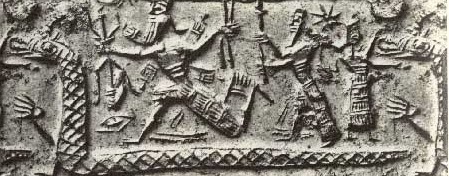
This was my first live radio show, with lots of shaky beginnings and nervous gulps, but as Archbishop Desmond Tutu would say, 'so far as I can make out, the sky is still in place'!  In the spirit of a new week beginning, a new year beginning, and this new show beginning, I felt it appropriate my first show only take on the theme of 'cosmogonies' and 'beginnings'. I tried to introduce a number of cosmogonies from various spiritual traditions, in addition to some critical reflections on the Genesis cosmogony from my own faith tradition. The image below is from a Babylonian cylinder seal relief depicting Marduk's victory over Tiamat, a mythology that shares imagery and concepts with the Hebrew cosmogony of Genesis.


episode download available: here


0:01:34 - psa: David Suzuki on eating local

0:01:54 - promo: pro-bono radio show
0:02:47 - 'Sacred Ground' by David Maracle
0:06:13 - 'Veni Creator Spiritus' by Coral Vertice
'":"":"" - (talking: about iroquoian love flute and cosmogonies)
0:09:46 - 'Instant 0' by Bernard Parmegiani
0:14:29 - 'Cosmogony' by Bjork
0:19:19 - 'First Selam' by The Mevlevi Ensemble of Turkey
'":"":"" - (talking: about the first selam and Catherine Keller) [1][2]
0:23:40 - 'Face of the Deep' by Wayne Shorter
0:29:19 - ad: the senior's centre
0:29:51 - promo: below the decks (radio show)
0:30:23 - 'Genesis' by Toru Takemitsu
0:39:25 - 'Beautiful Things' by Gungor
0:44:34 - 'Eden' by Toro y Moi
0:49:05 - talking: about Paul Tillich's reading of Genesis, and the cosmic egg [3]

0:52:08 - 'Triangle' by Sounds from the Ground
1:02:16 - psa: Noam Chomsky on community radio
1:03:02 - promo: women's word (radio show)
1:03:22 - ad: paradiso's pizza
1:03:58 - 'I Live Inside an Egg' by James Pants
1:06:10 - talking about: 'golden egg' of the upanishads, irish mythology, and Annie Dillard
1:08:40 - 'Genesis Theme' by Ravi Shankar
1:10:02 - 'The Tides of Manunaun' by Henry Cowell
1:13:11 - 'Me To Datee' by Danielson Famile
1:16:45 - 'Songline' by David Hudson and Steve Roach
1:19:46 - talking about: 'golden egg' of the upanishads, irish mythology, and Annie Dillard
1:22:20 - 'Creation' by Iasos
1:24:02 - 'Genesis' by Grimes
1:28:17 - promo: OPIRG
1:28:58 - promo: suspended particulate (radio show)
1:29:30 - promo: civic guilt
1:30:30 - station id: Jack Layton 

"Why didn't someone hand those newly sighted people paints and brushes from the start, when they still didn't know what anything was? Then maybe we all could see color-patches too, the world unraveled from reason, Eden before Adam gave names. The scales would drop from my eyes; I'd see trees like men walking; I'd run down the road against all orders, hallooing and leaping... It is ironic that the one thing that all religions recognize as separating us from our creator--our very self-consciousness--is also the one thing that divides us from our fellow creatures. It was a bitter birthday present from evolution, cutting us off at both ends...
Self-consciousness... hinder[s] the experience of the present. It is the one instrument that unplugs all the rest. So long as I lose myself in a tree, say, I can scent its leafy breath or estimate its board feet of lumber, I can draw its fruits or boil tea on its branches, and the tree stays tree. But the second I become aware of myself at any of these activities... the tree vanishes, uprooted from the spot and flung out of sight as if it had never grown. And time, which had flowed down into the tree bearing new revelations like floating leaves at every moment, ceases. It dams, stills, stagnates. Self-consciousness is the curse... Innocence is a better world. Innocence sees that this is it, and finds it world enough,"
- Annie Dillard (Pilgrim at Tinker Creek)


Further Info (if you're interested):
[1] 'The Face of the Deep: A Theology of Becoming' by Catherine Keller
[2] Video Lecture of Mary-Jane Rubenstein on the Multiverse (with a neat introduction to Catherine Keller's reading of Genesis, and other interesting theologians and scientists inside and outside of their respective 'orthodoxies'.)
[3] 'The Eternal Now' by Paul Tillich


Thursday, 26 December 2013

Favourite Releases of 2013

Though, in some sense, unrelated to this radio show, I thought I would share this here anyways. This is a list of music releases I really enjoyed from 2013, in no particular order. They are to some extent my personal 'favourites' from the year, as of late December. I've marked off the ones that I personally feel to be more accessible or 'listenable' with (*). There are 34 selections in the main list in total.


'fire moss' by fire moss 

'no answer : lower floors' by wolf eyes
(*) 'cerulean salt' by waxahatchee


OTHER RELEASES - I definitely enjoyed these as well:
'the man who died in his boat' by grouper
'anything in return' by toro y moi
'the 20/20 experience' by justin timberlake
'nothing was the same' by drake
'days are gone' by haim
'night time, my time' by sky ferreira
'yeezus' by kanye west
'modern vampires of the city' by vampire weekend
'pure heroine' by lorde 
'virgins' by tim hecker
'lines' by julian lynch

My end-of-year list from last year (and other lists going back to 2009) can be viewed here.

Thursday, 19 December 2013

Episode 0 // The Hexateuch

This is the demo I made when applying to get this radio show on air. This is the first time I'm doing anything like this and I'm actually really excited for this to happen in the coming semester, so I hope you enjoy. I put the track timings down so you can skip parts you're not into. For example, at 36:22 into the show there is a harsh noise track and I know a lot of people are not that into that sort of stuff, so skip away! (Or take it on if you're feeling adventurous.) Thanks for checking this out.

By the way, this demo show is loosely based around the theme of the Hexateuch (Torah + Book of Joshua), which are the first six books of the Hebrew bible. The image below is from an Old English Hexateuch from Canterbury, England, dated to the first half of the 11th century. It is an image of Adam naming the animals. The choice of theme has a lot to do with me being busy at the time and choosing a theme I was already somewhat familiar with because of my faith background. But I want to assure everyone that I will definitely be exploring themes outside of Judeo-Christian tradition, such as those meandering through the beautiful Vedas and Upanishads, the Analects, the Tao Te Ching, Sufi writings, the I Ching, a variety of indigenous texts and religions and a whole lot of other spiritual repositories. So not to worry! They are ~coming~ (image source: The British Library Board).


  episode download available: here

00:00-00:19 - demo introduction
00:20-02:32 - Hopi (People) - 'Hopi Coming Out Song'
02:33-05:49 - talking: about Hopi people and Genesis trees [1],[2]
05:50-09:57 - Actress - 'Tree of Knowledge'
09:58-16:28 - Steve Reich Ensemble - 'Act 3. Who Is Abraham?'
16:29-19:48 - talking: about Hebrew patriarchs
19:49-23:55 - Chelsea Wolfe - 'Moses'
23:56-24:09 - psa: David Suzuki
24:10-24:51 - psa: OPIRG
24:52-29:28 - Dave Brubeck - 'Forty Days'
29:29-31:40 - talking: about numeric themes [3]
31:41-36:21 - Woven Hand - 'Dirty Blue'
36:22-44:37 - Wold - 'Free Goat of Leviticus'
44:38-47:25 - talking: about noise and gematria
47:26-50:29 - Steven Lugerner - 'These Are The Words'
50:30-53:37 - King's Messengers - 'Jericho Road'
53:38-57:09 - talking: about promised land typology
57:10-1:00:39 - Charlie Louvin - 'I Am Bound for the Promised Land'

"[T]he Hexateuch itself may, and indeed must, be understood as representative of a type of literature of which we may expect to be able to recognize the early stages. the circumstances of composition, and the subsequent development until it reached the greatly extended form in which it now lies before us." - Gerahard von Rad (The Form-Critical Problem of the Hexateuch).


Further Info (if you're interested):
Show Corrections
1.) I pronounced 'leitourgia' incorrectly throughout the entire show, lol, and a lot of other things as well, like the 'Levant'.
1.) At 18:39, I said Moses liberated the people from Israel, but I meant Egypt.
2.) I switched the order that Numbers and Leviticus actually appear within the Pentateuch, totally by accident and did not realize until later.
3.) I said Steve Lugerner, but it's actually Steven Lugerner. I also said Charles Louvin, but it's actually Charlie Louvin.
4.) Jeff Tweedy was not involved in Steps to Heaven but another release by Louvin from 2007 that was self-titled.